Grief in Motion
- Jan 15
- 5 min read

The definition of grief... the complex, multifaceted emotional, physical, and psychological response to a significant loss—such as death, divorce, job loss, or illness. Grief isn’t always in the form of losing a loved one, but I think it’s one everyone can relate to.
Grief caught up to me recently while I was running. Not when my legs were tired. Not when I couldn't catch my breath. But somewhere in the middle—when my body found its rhythm and my mind finally had room to wander. One step after another, and suddenly a heaviness settled in that I couldn’t outrun. The truth is, I had been blessed to dodge grief for most of my life. Loss always felt distant—something that happened to other people. Until about two years ago, when my Mamaw passed away after a battle with Alzheimer’s and dementia. There were signs at first. Small ones. Forgetful moments that could’ve easily been chalked up to old age. But then it was like someone flipped a switch inside her. One year I was visiting her and my Papaw in Florida, laughing and talking like normal. The next year… it wasn’t the same. I got less phone calls, the texts eventually stopped. It was hard. And it just kept getting worse. Slowly. Then all at once.
That kind of grief is different. It’s like losing someone while their physical body is still here. You grieve them over and over—every visit, every phone call, every moment you realize a little more of who they were is gone. It was exhausting. And heartbreaking. And it still is.
My Mamaw passed away on September 30—one day before her and my Papaw’s 57th wedding anniversary. And what makes it especially hard is that my husband and I got married on their 50th anniversary. So every year, it brings a mix of emotions. Sadness, yes—but also happiness. Because how many people get to say they share such a special date with their grandparents? It’s grief and gratitude wrapped together, and I don’t think one cancels out the other.
Sadly, my Papaw passed away nearly a year later—of a broken heart, literally. So I guess you could say I’ve experienced quite a bit of grief these past two years.I think about them both every day—but especially my Mamaw. She was my voice of reason. She gave the best advice, even when she knew it wasn’t what I wanted to hear. She was the first person I called with good news and the first person I leaned on when things felt heavy. Growing up, if I wasn’t out of town showing horses or dancing at a basketball or football game, it was their house I went to. They lived on a farm—and the little zoo they ended up with was mostly my fault. One dog because of me. One cat because of me. A second cat because of me (though I think it ran away). And one horse—definitely because of me. Anytime an animal needed a home, I knew exactly where to take it… because I also knew they’d never say no.
Grief hits me the most when life is full—whether that fullness comes from joy or struggle. When life is heavy and I’m going through something, I wish nothing more than to call her. And when life is good, I want to call her just to tell her all the good things—to hear her say, “I’m proud of you.” That ache never really goes away. When grief hits me, I tend to hide it from others—but I also let myself feel it. I let myself cry it out. Sometimes that looks like a good cry in the shower. Sometimes it’s a long run on the treadmill. (And y’all… sometimes your best runs are ran sad or mad. IYKYK.) I’ve learned that bottling it up only makes it heavier. Letting it out—honestly and fully—helps me breathe again.
Alright, let's bring it home. Psalms 147:3 says, “He heals the brokenhearted and bandages their wounds.” Not instantly. Not painlessly. But faithfully. Grief doesn’t follow a timeline, I know you've heard that before. It doesn’t disappear because enough time has passed. Some days it hits unexpectedly—mid-run, mid-memory, mid-breath. And it doesn’t mean we’re going backward. It means we loved deeply.
I also remind myself of what gives me peace. That she’s no longer in pain. That she—and my Papaw—are in heaven. That she has her mind again. And that truth alone brings me so much comfort. I like to imagine her there, waiting on me, ready to cook me a big plate of spaghetti when I get there. And honestly… that picture settles my heart more than anything else.
If I can offer one small piece of advice to anyone walking through grief—hold your loved ones close. And if you can, get their voice on recording. I have a voicemail from my Mamaw from before Alzheimer’s, and I listen to it often. “Hi Pudd (IYKYK)… this is Mamaw. Sorry I missed your call. Call me back. Love you.”
Every time I hear it, it feels like a piece of her is still with me.
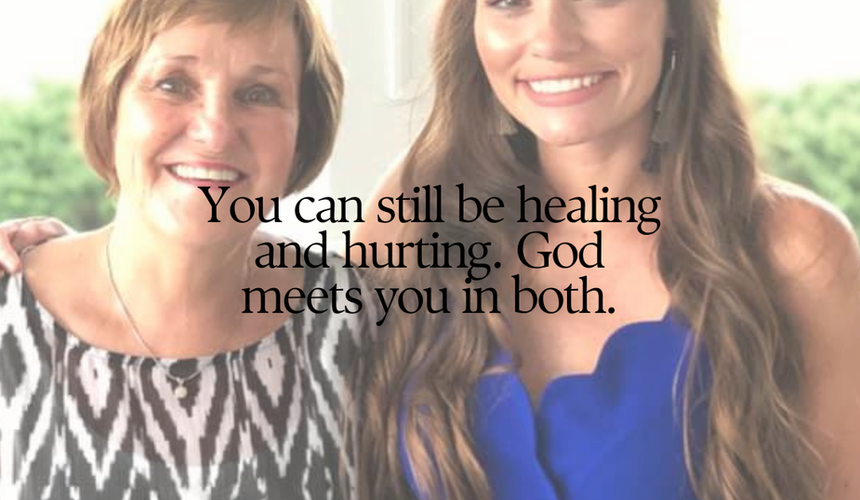
I’m learning that God doesn’t ask us to outrun grief. He asks us to let Him meet us in it. To be honest about what still hurts. To stop pretending we’re fine when we’re not. Healing doesn’t come from avoiding the pain—it comes from bringing it into His presence. Sometimes grief looks like tears mixing with sweat. Sometimes it looks like finishing the run anyway. Sometimes it looks like whispering, “God, this still hurts,” and trusting that He’s close enough to hear it. So if grief finds you while you’re moving—don’t be surprised. Let God meet you there. You’re not weak. You’re not failing. You’re human. And you’re deeply loved.
IF you haven't gotten that lump in your throat yet, I encourage you to watch this. Life is short, hold on to your loved ones.
SHE Walks in Faith
Where does grief show up for you—quietly or unexpectedly? Pause today and invite God into those moments, even the ones you usually hide.
When it shows up, here are some things that help me.
Let yourself feel it instead of rushing past it. Grief doesn’t need to be fixed—it needs to be felt. Some days that means tears, other days it means sitting in silence and letting your heart catch up.
Move your body when your mind feels heavy. A long run, a short walk, stretching, or just stepping outside helps release emotions
Talk to God the way you would talk to him/her. Tell Him everything—the good, the hard, the messy. He can handle my honesty.
Give yourself permission to grieve differently day to day. Some days feel light. Others don’t. Both are normal. Healing isn’t linear, and neither is grief.
Hold onto reminders of hope. Remembering he/she is no longer in pain, that they're whole, and that they're with Jesus gives, it'll give your heart peace when the ache feels loud.
Stay connected to their voice and memory. A voicemail, a recipe, a photo, a familiar phrase—those small things keep love close.
Lean on your people. Even when I want to hide it, sharing my grief with someone who understands reminds me I’m not alone.
Be gentle with yourself. Grief is exhausting. Rest isn’t weakness—it’s necessary.
Grief looks different for everyone. There’s no timeline, no rulebook, and no “right” way to do it. But God meets us exactly where we are—and He stays.
🩷 Prayer
God, thank You for meeting me in my grief and giving me peace where I need it most. Help me honor the ones I’ve lost while trusting that they are whole with You. When my heart feels heavy, remind me I’m not carrying it alone. Amen.